

I’ve written a Personal Development Plan every year for as long as I can remember. They’ve always looked perfectly respectable. Spreadsheet-based. Neatly structured. Full of learning objectives, activities, timelines, and success measures. The sort of thing that has always had my managers nodding approvingly and then quietly forgetting about until the next review cycle (although I’m sure my truly brilliant current boss would deny any such thing).
The problem is, they never really changed how I behaved.
So when I started my PDP for 2026, I didn’t want another list of good intentions I’d cram into the final quarter. I wanted something that reflected how I’m trying to operate in more senior roles, so I used ChatGPT as a thinking partner to pressure-test whether my plan meant anything in practice, not to write it, but to challenge it.
Note: throughout this post, I’ll refer to ChatGPT as my (current) AI chatbot of choice. But the same principles will apply if you want to use another similar AI tool such as Gemini, Copilot, Claude, or Grok. Each will produce different results and some are better than others for different types of “thinking” so feel free to test more than one and see which you find most useful. Let me know in the comments!
TL;DR: I used ChatGPT as a strategic thinking partner to shift my PDP from activity lists to behaviour-focused outcomes.
👉 If you want to try this yourself, jump to the HANDS ON section.
Where I started and what wasn’t quite working
My starting point was familiar territory. An Excel PDP with sections for learning needs, activities, resources, timelines, and success measures. There was nothing obviously wrong with it, which is probably why I’d left it largely unchanged for years.
But reading it back, and being really honest with myself, it was very activity-led. It focused on what I would do rather than how I would show up differently if the plan worked. There were plenty of courses, initiatives, and “develop deeper understanding of…” type statements, but very little that answered a more uncomfortable question: what would actually change day to day?
As I’ve progressed in my career, that gap has started to matter more.
The uncomfortable shift: from activity to impact
The most useful moment came from a deceptively simple question from Jeep (my affectionate nickname for my ChatGPT): what would look different if this PDP actually worked?
It became obvious how often I was hiding behind language that sounded senior but didn’t describe a behaviour I could point to. One of my original lines literally said something like “increase strategic influence”, which felt impressive right up until I tried to explain what that would look like on a Tuesday afternoon.
The back-and-forth dialogue through thoughtful prompting with ChatGPT helped me:
| Move away from: | Focus more on: |
| Outputs | Outcomes |
| Listing courses and certifications | Observable behavioural change |
| Stacking initiatives on top of a busy role | Fewer, more targeted activities |
| Equating effort with progress | Creating impact rather than being busy |
It also surfaced a few patterns I’d prefer not to admit to, like how easily I default to delivery mode, how often I take up things “to be helpful”, and how comfortable I am being useful rather than influential. None of this was new information, but seeing it reflected back without judgement made it harder to ignore or rationalise away.
Rethinking the plan – three pillars that actually mean something
Eventually, my new PDP distilled into three strategic pillars. Not because three is a magic number, but because anything more than that and I know I’ll quietly abandon it.
Strategic Influence
This pillar is about influencing direction earlier and more consistently, rather than being brilliant at executing decisions that have already been made. In practice, that means better problem framing, asking sharper questions, and offering perspective instead of immediately jumping to solutions.
Leadership and Leverage
This is focused on scaling impact through people and systems, not personal output. It covers delegation (the real kind, not “I’ll just do it quickly myself”), coaching over solving, and investing in ways of working that don’t depend on me being involved in everything. There are also clear signals for when not to step in, which sounds obvious, but is surprisingly hard to stick to in practice.
Focused Development
This pillar is about depth over breadth. Fewer courses, more application. Less collecting learning for the sake of it (gotta catch ’em all!) and more embedding what actually matters. This was a conscious move away from continuous professional development that’s interesting but non-essential, which I’m very good at justifying if left unchecked.
What makes this PDP different from the others
Each pillar now includes:
- A clear 2026 outcome
- Specific behaviours to lean into
- Explicit “do less” or “stop” behaviours
- Practical, observable evidence of progress
- A quarterly reflection prompt so it doesn’t quietly die in a folder
That structure means this PDP is something I can realistically revisit, rather than something that only reappears when a review meeting looms.
What ChatGPT actually added to my PDP (and what it didn’t)
ChatGPT didn’t generate the ideas in this plan. Most of them were already there, just badly expressed or half-formed. What it did do was force me to slow down and notice where I was being vague, repetitive, or overly polite to myself.
I lost count of the number of times I’d written something that sounded good but fell apart the moment I asked, “how would I know if I was doing this?” Having that challenged neutrally, without ego or agenda, was surprisingly effective. Occasionally uncomfortable, but useful.
It was particularly good at spotting where I was describing activity instead of outcome, effort instead of impact, or intention instead of behaviour. That’s much harder to see when you’re close to your own work and already half-convinced it makes sense.
The end result – a PDP focused on outcomes, not activities
The final PDP feels different. It’s clearer, more honest, and far more usable. It reads as senior without leaning on corporate jargon, and it’s practical enough to revisit quarterly rather than once a year out of obligation. It finally reflects how I want to operate, not just what I want to add to my workload.
HANDS ON
How you can use ChatGPT to improve your own PDP
If you want to try this yourself, you don’t need to start from scratch or do anything particularly fancy. What mattered for me wasn’t the tool, but how I used it. Here’s a simple way to approach it.
1. Start with what you already have
Take your existing PDP, even if it’s a mess. Upload or paste the whole thing into ChatGPT. Don’t edit it first. The point is to work with what’s actually there, not what you wish you’d written.
If you don’t have a PDP yet, you have two options:
Option 1: Use a simple template
If you’d rather start with something structured, you can use my free PDP template here.
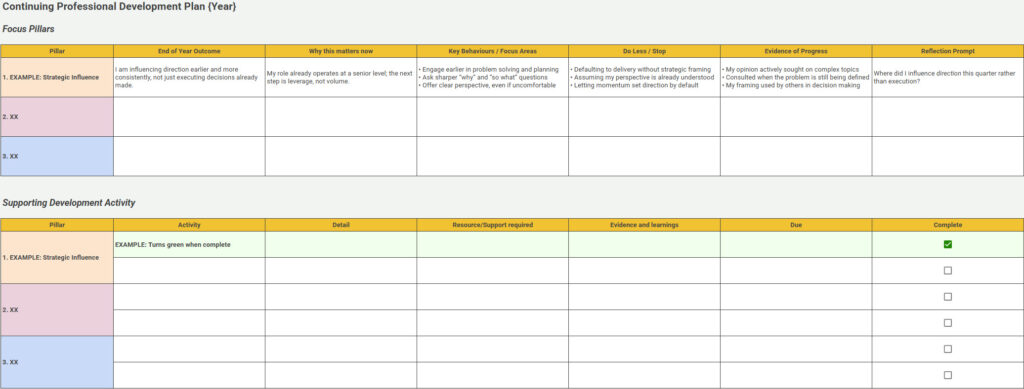
Option 2: Start from a blank page using ChatGPT
If you prefer to begin from scratch, paste the following prompt into ChatGPT:
I’d like you to act as a thoughtful career advisor rather than a generic coach. I want to create an annual Personal Development Plan that focuses on how I show up and create impact at work, not just a list of courses or activities.

Before suggesting anything, please ask me ten questions to understand my current role, level of seniority, strengths, frustrations, habits, and long-term ambitions. Prioritise questions that will help identify behavioural changes and areas where I could create more impact, not just skills I could learn.

Once I’ve answered, I want your help turning those insights into a small number of clear development priorities for the year.
The goal here isn’t a perfect plan. It’s a starting point you can interrogate and improve.
2. Ask outcome-based questions, not “make this better”
When you have an initial direction and some general guidance from your new AI career advisor, ask ChatGPT how you can ensure your plan is focused on outcomes. For example, try prompts such as:
If this plan worked, what would I be doing differently in a normal work week?Turn this goal into a clear behaviour I could test and measureWhat’s something I could stop doing that would free up room for this change?These questions are uncomfortable in a useful way. The discussion can prompt meaningful redirection and focus.
3. Turn vague lines into observable behaviour
When ChatGPT highlights vague or generic language, paste that line back in with this prompt:
Turn this into a behaviour with an observable success measure I could check quarterly.For example, instead of:
Improve strategic influence
you might get:
Lead two cross-team framing sessions per quarter and share the outcome with my manager.
4. Introduce explicit “do less” behaviours
This was one of the biggest improvements I made. For every new behaviour you add, ask yourself (or ChatGPT):
What should I deliberately doing less of as a result?What would I need to stop doing for this to be true?Where am I likely to overstep out of habit?Writing these down makes the plan far harder to ignore later. ChatGPT helped me identify some really valuable blind spots and inefficient behaviours that I could consciously try to stop or reduce.
5. Limit yourself to a small number of pillars
Resist the urge to cover everything. Two or three focus areas is usually plenty. Any more than that, and the PDP becomes aspirational rather than usable.
If something doesn’t make the cut, it doesn’t need to disappear forever, it just doesn’t get centre stage this year.
6. Add a reflection prompt you’ll actually revisit
Finally, include a short quarterly check-in question, such as:
What have I done differently in the last three months because of this PDP?Where have I slipped back into old habits?What would make the next quarter more intentional rather than just busier?If your PDP can’t answer those questions, it’s probably too abstract. Make sure you schedule quarterly PDP check-ins to consider your prompts!
The takeaway – ChatGPT can be a truly brilliant (and cheap) career coach
Used well, ChatGPT can be a genuinely useful reflective partner for development work. Not a shortcut, and definitely not a replacement for thinking, but a way of moving from doing more to doing the right things differently.
For me, that’s exactly what a PDP should be doing.
The best part? This whole exchange cost me virtually nothing. Find me a better career coach for that price, I challenge you 😉
Em, this is brilliant, structured, inspiring, honest and thought provoking – thanks for sharing this, already creating positive impact for others!
Thanks Hayley, that really means a lot. And yes, the irony of using AI to keep the grey matter working is definitely not lost on me!
Had this book marked for a few weeks Em. I’m going to give it a go myself, nice share and great explanation 👍
Thanks Dave – good luck! Hope you’re doing well too!
Hey! Your energy is amazing.